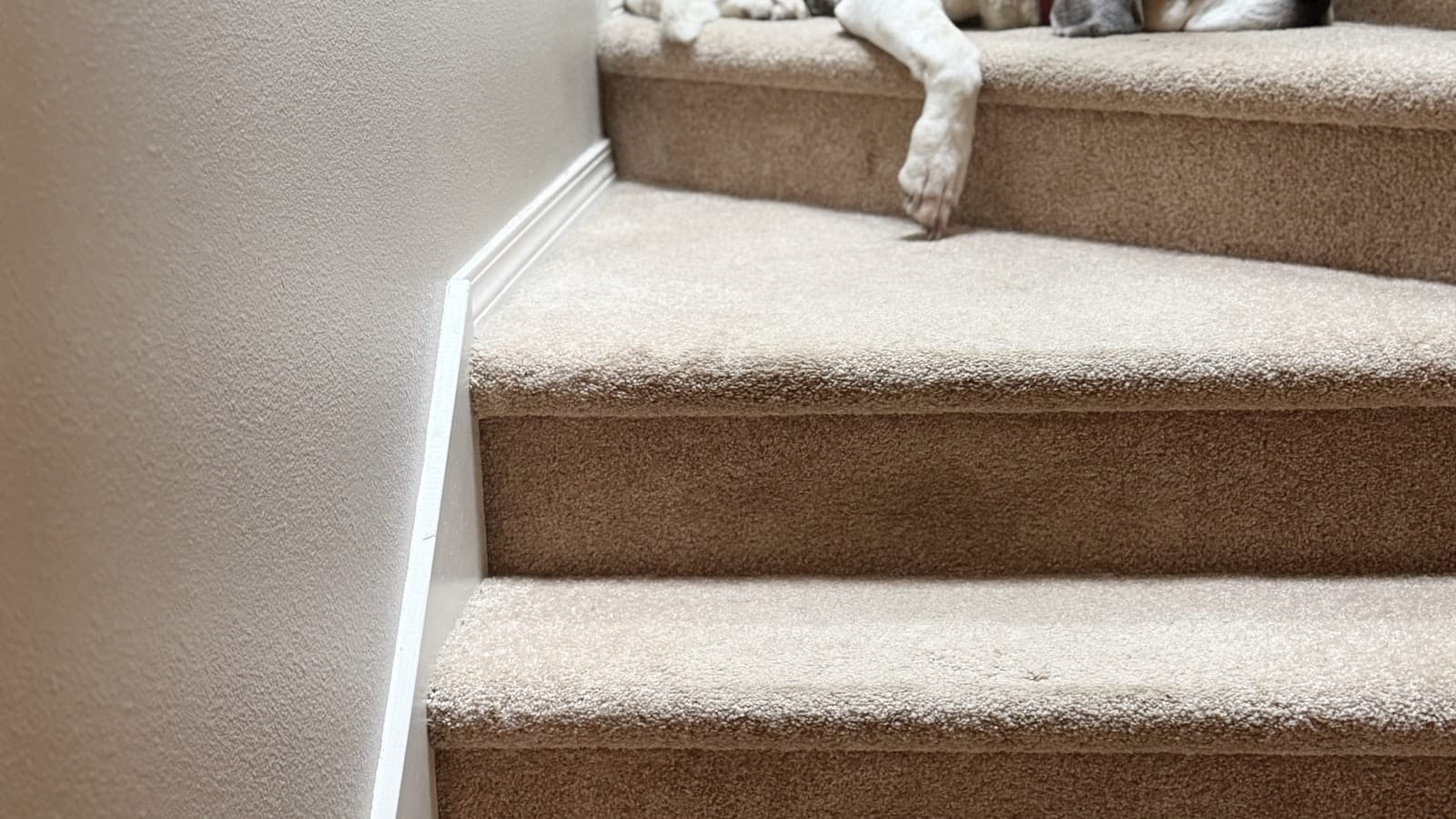
She used to take them in twos. Now she pauses at the bottom, looks at you, and waits.
Stairs are one of the earliest places older dogs start to show us they are slowing down. They are also one of the easiest places to help, because most of what makes stairs hard is fixable at home, with no veterinary intervention and a small Saturday spent rearranging the house.
This guide walks through eight changes that actually work, in order of impact. Three of them cost nothing.
The short version
- Put runners or rugs on slippery stairs (single biggest fix)
- Move her sleep spot downstairs so she only does the climb once or twice a day
- Add a non-slip landing at the top and bottom
- Use the right lifting technique on the bad days
- A ramp for the car and sofa changes everything
- Build hindquarter strength with gentle hill walks and sit-to-stand reps
- Brighten the stairwell
- Notice when confidence, not pain, is the real problem
If she is genuinely struggling on most days, see the vet alongside doing all this. There is a section below on what to look out for.
Why stairs are uniquely hard for older dogs
Four things compound on stairs, and they hit older dogs all at once.
Joint load. Going up stairs nearly doubles the force through the hindquarters compared with flat walking. Coming down can be worse, because the joints have to absorb impact rather than push off. For a dog with early arthritis, this is the activity their joints object to most.
Hindquarter muscle. Older dogs lose muscle mass over the hips and thighs faster than other parts of the body. Less muscle means more load goes through the joint and less through the surrounding tissue. The dog feels it.
Eyesight. Most older dogs lose some depth perception, particularly in low light. Stairs become harder to judge.
Confidence. After one slip or one stumble, many dogs lose confidence on a specific staircase. They will manage stairs at the café just fine, then refuse the ones at home.
The good news: each of these has a practical fix, and they all stack.
Eight practical changes that work
1. Add a runner or rugs on slippery stairs
If your stairs are hardwood, laminate or tile, this is the single biggest change you can make. Slippery treads make every step risky for a dog with weak hindquarters, and the anticipation of slipping is exhausting on its own. A long stair runner is the cleanest fix, but rubber-backed individual stair-tread pads work equally well and are cheaper. Aim for full coverage across each tread, not just a strip in the middle.
2. Reduce the number of trips
Older dogs do not need to follow you up and down twenty times a day. Most of the wear and tear on stairs is unnecessary repetition. Bring her bed, her water bowl and her favourite resting spot down to the ground floor if she sleeps there now. If she sleeps upstairs, make the morning toilet break the first thing she does, so she only descends once. Two slow, supported trips a day beats fifteen quick ones.
3. Non-slip surfaces at the top and bottom
Both ends of a staircase are where most slips happen. The dog is either committing to the first step (and slipping on the landing) or recovering from the last step (and skidding into the hallway). Add a rubber-backed mat at each end that is wider than the staircase, so she has a clear landing zone.
4. Pick her up properly on the bad days
Most owners lift older dogs by hooking under the belly. This is the worst place to lift from because it puts pressure on the back and on the abdomen. The right technique: one hand or forearm under the chest, in front of the front legs. The other hand or forearm under the bottom, supporting the back end. Lift in a single smooth motion. For larger dogs, this is a two-person job. Do not be embarrassed about that.
5. A ramp for the sofa, bed and car
Jumping into the car and onto furniture is the same problem as stairs in miniature. A foldable car ramp costs around £40-£70 in the UK and pays for itself in spared joint wear within months. For furniture, foam pet ramps work but tend to feel wobbly to dogs. A small set of pet steps with a non-slip surface is usually more reassuring. Train your dog to use it before you actually need it; do not introduce it for the first time during a flare-up.
6. Build the hindquarters with the right exercise
Counterintuitively, the answer is not less exercise. Done right, gentle daily activity is one of the best things for joint health. The aim is to build the muscle that supports the joint, not the kind of high-impact effort that strains it. Two simple at-home strength exercises work well. The first is gentle hill walking: a slow walk up a slight incline, three to five minutes a day. The second is sit-to-stand transitions: ask her to sit and then stand, repeated five to ten times in a row, twice a day. Both build hindquarter strength without joint impact. Hydrotherapy, where available, is even better.
7. Brighten the stairwell
A surprising number of older dogs slow on stairs simply because they cannot see them clearly. Adding a wall light at the bottom, or a motion-activated stair light, makes a real difference for any dog with even mild visual decline. If your stairwell has high-contrast carpet, that is good. If your treads and risers are visually similar (both pale wood, both grey), consider adding a contrasting tape strip or runner colour to mark each tread edge. Dogs see contrast far better than they see colour.
8. Notice when confidence is part of the problem
If your dog suddenly refuses a staircase she has used for years, especially if there was no flare-up first, the issue may be psychological as much as physical. One bad slip can leave a dog reluctant to try again. This is fixable. Spend two or three days at the bottom of the stairs, treating her for one calm step, then turning around. Do not push for the full flight. Confidence rebuilds in small increments. If she does not regain it within a week or so, see your vet to rule out anything physical you have missed.
When stairs trouble suggests it is time to see the vet
If your dog meets any of these alongside stairs trouble, book a vet visit:
- Outright refusal to use any stairs, even with all the changes above
- Crying out or yelping on certain steps
- A sudden change from yesterday to today rather than gradual decline
- Limping or carrying a leg afterwards
- Loss of bladder or bowel control going up or down
- Marked muscle thinning over the back legs
Some of these suggest a specific joint problem, such as a cruciate ligament tear or a disc issue, rather than slow-burn arthritis. Worth ruling out properly. There is more in our guide on the early signs of arthritis if you are not sure where she sits on that spectrum.
What joint supplements can and cannot do
A joint supplement is not a stair fix on its own. The biggest gains by far come from the changes above. But for a dog already in the window where arthritis is starting to bite, supplements can support what those lifestyle changes are doing.
What a good one helps with: ongoing cartilage health, low-grade inflammation, and the cellular pathways that drive joint repair. What it does not do: instantly improve a Tuesday morning's stairs. Effects accumulate over weeks, not days.
The multi-pathway formulations work better than single-ingredient ones for most dogs, especially in the prevention window. Tailkind's Joint Care Mobility Chews cover structural, anti-inflammatory and cellular support in a single chew. If you want a wider view, we have a fuller review of the UK joint supplement landscape and a separate guide on when to start a joint supplement that walks through the timing for different breeds.
A note on going up versus coming down
Going up loads the back legs hardest at the push-off. Coming down loads them hardest on the landing.
For most arthritic dogs, coming down is harder. The brain knows the landing is coming and braces, which adds tension to the joint before the impact lands. Watch your dog on a descent: a tense, stiff descent often suggests discomfort is further along than you thought.
Two practical implications. First, give her time on the way down. Do not rush her or call her down impatiently. Second, if she will descend confidently when you walk beside her rather than at the bottom, do that. Many dogs descend more easily when they are not feeling watched from below.
Frequently asked questions
My dog refuses the stairs entirely. What now?
If the refusal is sudden, see the vet within a few days to rule out a specific injury. If it has come on gradually, work with what she can do: bring her sleep, food and toilet downstairs, use a ramp for the car and sofa, and start rebuilding step-by-step confidence at the bottom of the stairs with calm, low-pressure short sessions.
Should I carry my older dog up and down stairs?
For occasional support on the very bad days, yes, using the lifting technique above. As a permanent solution, no. Dogs with even modest arthritis benefit from continuing to do some stairs gently, on safe surfaces, because the muscle and joint movement is protective. Total avoidance speeds up the decline.
What kind of ramp is best for a UK family car?
Look for a folding ramp at least 150 cm long, with a non-slip surface and a stated weight capacity well above your dog's weight. Telescoping ramps save space but can wobble; rigid folding ramps are more reassuring for nervous dogs. Practise with treats on a flat floor before the first real use.
Can a small dog really benefit from a ramp?
Yes, sometimes more than a large dog. Small breeds, especially long-backed ones like dachshunds, are at much higher risk of disc problems. Repeated jumping on and off furniture is one of the established risk factors. A ramp removes that impact entirely.
Topics