Most owners can spot a terrified dog. The trembling, the tucked tail, the bolt for the door during fireworks: those are not subtle.
What slips past nearly everyone is the quieter end of the scale. The dog who yawns when nobody is tired. The dog who has become wonderfully, suspiciously calm. The older dog written off as grumpy who is actually worried, or sore, or both. Stress in dogs is under-read not because owners are not paying attention, but because the signals are quiet and easily explained away as personality.
This guide covers the obvious signs briefly, then spends most of its time on the ones we miss.
The short version
- Yawning, lip-licking or lip-smacking when not tired or hungry
- "Whale eye": the whites of the eyes showing as the dog turns away
- Sudden scratching or sniffing the ground in a tense moment (displacement behaviour)
- Going very still and "well behaved" under pressure (a shutdown, not calm)
- A gradual withdrawal: more sleep, less interest, labelled as ageing
- In older dogs especially, what looks like anxiety is often pain
The signs most people do spot
These are worth naming quickly so we can move on to the harder ones. Acute, obvious stress usually looks like: pacing, whining or barking, trembling, panting when it is not hot, destructive chewing, toileting indoors, hiding, or trying to escape. Most owners read these correctly, even if they are not sure what to do about them.
The problem is that these are the signs of a dog who is already over threshold. By the time a dog is doing this, the quieter signals have usually been going for a while.
The signs we often miss
Dogs have a whole vocabulary of low-level stress signals, sometimes called calming signals. They are easy to miss because each one, on its own, looks like ordinary dog behaviour.
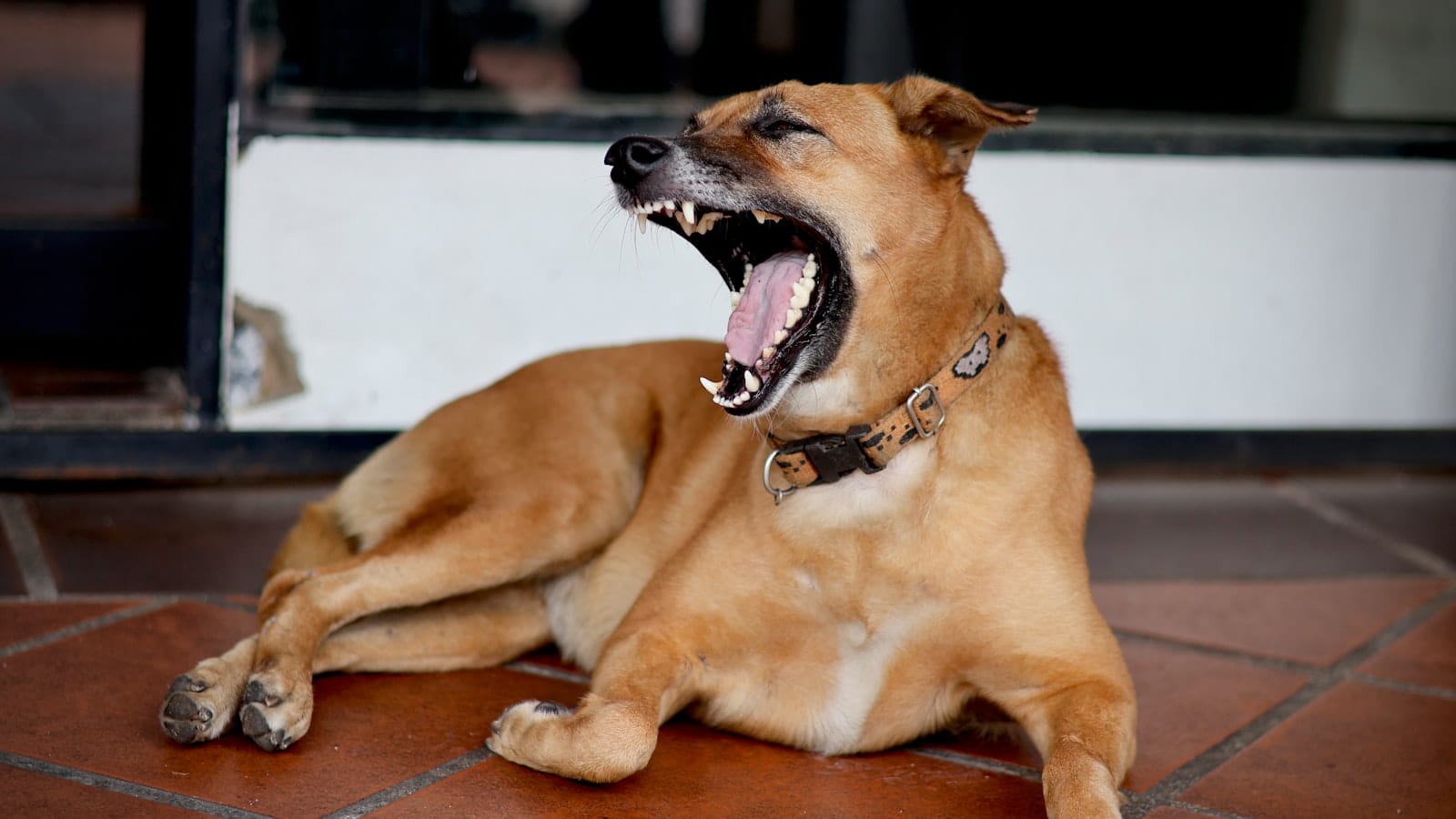
Lip-licking and yawning out of context. A single lick of the lips when there is no food, or a yawn when the dog is not remotely tired, is one of the most reliable early stress tells. Watch when you hug your dog, or when a stranger leans over them. One quick tongue flick is the dog saying "I am not comfortable".
Whale eye. The dog turns the head away but keeps watching, so you see a crescent of white at the edge of the eye. It usually means the dog wants the situation to stop but is not escalating.
Displacement behaviours. Sudden, out-of-place actions in a tense moment: scratching as if itchy, sniffing the ground intently, a big shake-off as though wet when bone dry. These are the canine equivalent of a person straightening their tie before a difficult conversation.
The freeze, and the shutdown. This is the most misread of all. A dog under real pressure who has learned that nothing they do changes it may go very still and very "good". Owners often read this as the dog being calm or well trained. It is closer to the opposite. A dog who has stopped trying is not relaxed; the body is usually tense, the mouth tight, the movements slow and careful.
Lifting a paw, turning away, moving in a curve. Small avoidance signals. A dog who consistently turns side-on rather than facing something, or arcs around another dog rather than walking straight up to it, is managing stress, not being aloof.
Acute stress versus chronic stress
This distinction matters more than any single sign.
Acute stress is the firework, the vet visit, the doorbell. It is loud, short, and usually obvious. It resolves when the trigger goes.
Chronic stress is the one owners miss for months or years, because it does not look like stress at all. It looks like a personality. A dog under long-term, low-grade stress often becomes withdrawn rather than dramatic: sleeping more, engaging less, slower to greet you, less interested in the things they used to love, occasionally a shorter fuse over being disturbed. Every one of those is also a description of "just getting older", which is exactly why it goes unaddressed.
If your older dog has quietly become a different, smaller version of themselves over a year or two, that is worth taking as seriously as a dog who panics at fireworks. It is just harder to see.
When pain looks like anxiety
Here is the one we most want owners to take away.
In older dogs in particular, behaviour that gets labelled "anxious" or "grumpy" is very often pain. A dog who has started growling when lifted, who no longer wants to be touched on the back end, who is restless at night, or who has become reactive to other dogs on walks may not have developed an anxiety problem. They may simply hurt, and be defending themselves the only way they can.
This is not a small effect. Studies of dogs referred for behaviour problems have repeatedly found undiagnosed pain as a major contributing factor in a large share of cases. The practical rule: any meaningful behaviour change in a middle-aged or older dog deserves a vet check to rule out pain before it is treated as a purely behavioural issue. Our guide on the early signs of arthritis covers what to look for, and our piece on when a dog becomes a senior covers the wider picture of change at this stage.
What actually helps
In rough order of impact.
Rule out pain first. Especially in any dog over seven, or any dog where the change was relatively sudden. This is the single most useful step and the most often skipped.
Predictability. Dogs cope far better with a world they can predict. Consistent routines, calm arrivals and departures, and not forcing interactions are unglamorous but more effective than most products.
Reduce the triggers you can. This is management, not failure. Fewer overwhelming walks, more sniffing time, a quiet space the dog can choose to use, covered crates for firework season planned well in advance.
Desensitisation done properly. Gradual, structured exposure at a level the dog can cope with, paired with good things. Done badly (too much, too fast) it makes things worse, which is why a qualified behaviourist is worth it for anything entrenched.
Calming support, realistically. Calming supplements can take the edge off the baseline for some dogs, alongside the work above, not instead of it. They are a support, not a fix, and they do not replace ruling out pain or addressing the environment. Tailkind takes an evidence-led approach across its range; their Joint Care Mobility Chews are available now, with a calming formulation in development.
When to involve your vet or a behaviourist
See your vet if a behaviour change is recent, sudden, or in an older dog, so pain and medical causes can be ruled out first. Ask for a referral to a qualified clinical animal behaviourist (in the UK, look for membership of the ABTC or APBC) for anything entrenched: real separation distress, serious noise phobia, reactivity that is not improving, or aggression. Anxiety that has been building for years rarely resolves on its own, but it responds well to the right structured help.
Frequently asked questions
Why has my dog suddenly become anxious?
Sudden behaviour change, especially in an older dog, should prompt a vet visit before anything else. Pain, sensory decline, and several medical conditions present as new anxiety. If medical causes are ruled out, look for a change in the dog's environment or routine, however small it seems to you.
How do I know if my dog is anxious or in pain?
You often cannot tell from behaviour alone, which is the point. Pain and anxiety produce overlapping signs: reluctance to be touched, irritability, restlessness, withdrawal. In any dog over about seven, or where the change was fairly sudden, assume pain is on the table until a vet has assessed them.
Do calming supplements work for dogs?
For some dogs they take the edge off the baseline level of arousal, which can make the behavioural work more achievable. They are a support alongside environment, routine and training, not a standalone fix, and they do not substitute for ruling out pain.
Can a dog grow out of anxiety?
Puppyish nervousness sometimes settles with calm, positive experience and maturity. Established anxiety in an adult or older dog generally does not resolve on its own; it tends to stay the same or worsen without intervention. The good news is that it usually responds well to a structured plan.
Topics