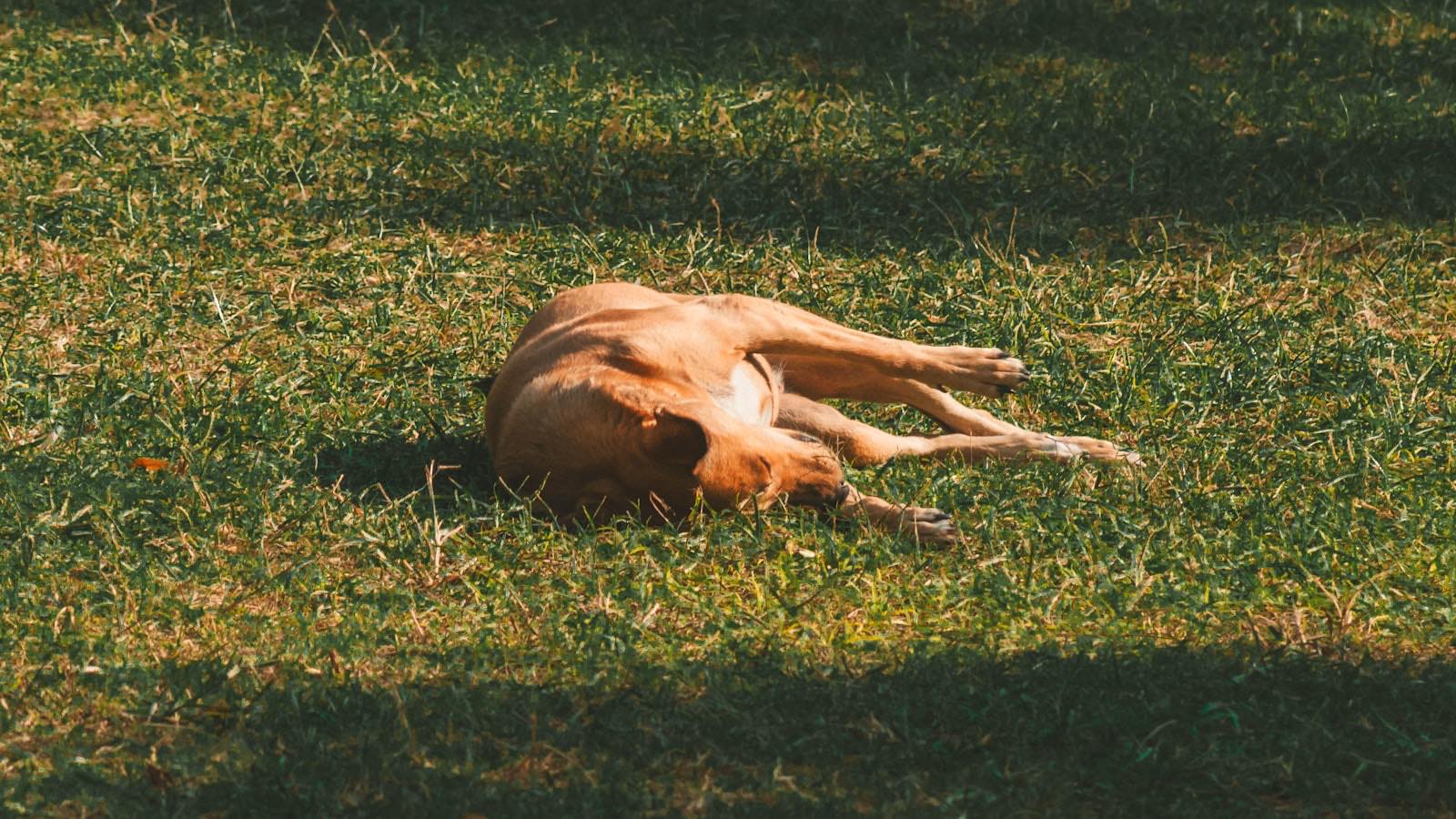
A British summer rarely feels dangerous. That is exactly why dogs end up in trouble: the day reaches 24 degrees, the sun is pleasant rather than fierce, and an owner takes their dog on the usual lunchtime walk without a second thought. By the time the dog is struggling, a lot of damage is already done.
Heat affects dogs far more than it affects us, and it affects older dogs first. This guide gives you the simple tests and temperature thresholds to make the call confidently, and the warning signs that mean stop now.
The short version
- Do the seven-second pavement test: press the back of your hand to the ground for seven seconds. If you cannot hold it there, it is too hot for paws.
- 20 degrees and above warrants caution; above 24 degrees, walk only in the cool of early morning or late evening.
- Older dogs, flat-faced breeds, overweight dogs and those with heart or breathing conditions are at the highest risk.
- Heatstroke signs: heavy frantic panting, bright red gums, drooling, wobbliness, collapse. Treat as an emergency.
- On hot days, swap the walk for shade, water, and gentle enrichment indoors. A missed walk never hurt a dog. Heatstroke kills them.
Why dogs overheat faster than we do
Humans sweat across the whole body. Dogs barely sweat at all, only a little through their paw pads, so they rely almost entirely on panting to shed heat. Panting is far less efficient than sweating, and it gets less efficient as the air around the dog warms up. On a hot, humid day a dog can take in heat faster than it can pant it away, and core temperature climbs.
This is why a temperature that feels merely warm to you can be genuinely dangerous to a dog, especially one walking, carrying a coat, and unable to tell you it is struggling until late.
The seven-second pavement test
Tarmac and paving absorb heat all day and hold it. On a 25-degree day, pavement can reach 50 degrees or more, hot enough to blister a dog's paw pads within minutes.
The test is simple. Before you set off, press the back of your hand flat against the pavement and hold it for seven seconds. If it is too hot for you to keep your hand there comfortably, it is too hot for your dog to walk on. Their pads are tougher than your skin, but not by enough to make this safe.
If the pavement fails the test, either wait for it to cool (early morning and late evening are reliably safer) or stick to grass and shaded ground.
The UK temperature guide
There is no single legal threshold, but UK vets broadly agree on a sensible scale. Treat these as guidance for a healthy adult dog, and step everything down a level for at-risk dogs.
- Up to 19 degrees: generally safe for normal walks. Carry water on longer outings.
- 20 to 23 degrees: take care. Walk in the cooler parts of the day, keep it shorter, avoid the midday sun, and bring water.
- 24 to 27 degrees: higher risk. Early morning or late evening only, on grass and shade, kept brief. Skip it entirely for at-risk dogs.
- 28 degrees and above: do not walk. The risk is not worth it for any dog. Provide shade, water and indoor enrichment instead.
Humidity makes everything worse, because it reduces how effectively panting cools the dog. A humid 22 degrees can be more dangerous than a dry 25.
Which dogs are most at risk
Some dogs handle heat far worse than others. Apply real caution to:
- Older dogs. Heat regulation becomes less efficient with age, and many older dogs have underlying conditions that the heat aggravates. If your dog is in the senior stage for their size, treat hot days conservatively.
- Flat-faced breeds. Bulldogs, French Bulldogs, Pugs and Boxers have airways that make panting much less effective. They overheat alarmingly fast and are over-represented in heatstroke cases.
- Overweight dogs. Excess body fat insulates and adds load, both of which make overheating more likely.
- Dogs with heart or respiratory conditions. Anything that already limits breathing or circulation reduces the margin for safe cooling.
- Thick-coated and dark-coated breeds. Huskies, Newfoundlands and similar carry coats built for cold; dark coats absorb more heat.
The signs of heatstroke
Heatstroke can develop within minutes and is a genuine emergency. Learn the progression:
- Early: heavy, fast panting; bright red gums and tongue; lots of drool; clear agitation or seeking shade.
- Worsening: thick, sticky saliva; wobbliness or a drunken gait; vomiting or diarrhoea; glazed expression.
- Critical: collapse, seizures, unconsciousness.
If you see the early signs, stop immediately, move the dog into shade, offer small amounts of cool (not ice-cold) water, and wet their coat with cool water, focusing on the belly, armpits and groin. Then ring your vet. If the dog is wobbly, vomiting or collapsed, treat it as a blue-light emergency and call the vet on the way, do not wait to see if it passes.
A note on cars: never leave a dog in a parked car in warm weather, even briefly, even with windows cracked. The inside of a car climbs to lethal temperatures in minutes. "Not long" is how most car heatstroke deaths happen.
What to do instead on a hot day
Missing a walk worries owners more than it should. A dog that misses one walk is mildly bored. A dog with heatstroke can die. The trade is not close.
On a hot day, replace the walk with:
- Early or late timing. Shift the walk to 6 to 8am or after 9pm, when pavements and air have cooled.
- Sniffing over distance. Ten minutes of nose-led pottering on shaded grass tires a dog more than you would think, with a fraction of the heat load.
- Indoor enrichment. A scatter-fed meal, a stuffed and frozen Kong, a snuffle mat, or a simple training session burns mental energy without physical heat.
- Cooling options. A paddling pool in the shade, a damp towel to lie on, free access to fresh water in more than one spot.
For older dogs whose mobility is already a consideration, the cooler mornings are also kinder on stiff joints, so the timing shift helps twice over. If joint comfort is part of your picture, our guide on helping an older dog stay mobile and the wider joint support options are worth a read for the rest of the year.
Frequently asked questions
At what temperature is it too hot to walk a dog in the UK?
As a rule of thumb, take real care from 20 degrees, walk only in the cool of early morning or evening from 24 degrees, and do not walk at all at 28 degrees or above. Step every threshold down for older dogs, flat-faced breeds, overweight dogs and those with heart or breathing conditions. Humidity raises the risk at any given temperature.
How do I know if the pavement is too hot for my dog?
Press the back of your hand flat against the pavement for seven seconds. If you cannot hold it there comfortably, it is too hot for your dog's paws and can cause burns. Walk on grass and shade instead, or wait for early morning or late evening when surfaces have cooled.
What are the first signs of heatstroke in a dog?
Heavy, frantic panting, bright red gums and tongue, heavy drooling, and obvious agitation or shade-seeking. As it worsens you may see wobbliness, vomiting, and a glazed look. Collapse and seizures are critical. At the first signs, move to shade, offer cool water, wet the coat, and call your vet immediately.
Is it cruel to skip my dog's walk when it is hot?
No. A missed walk is a minor inconvenience to a dog; heatstroke can be fatal. On dangerously hot days, swapping the walk for shade, water, sniffing games and indoor enrichment is the responsible choice, not a failing. Dogs cope perfectly well with an occasional rest day, especially when the alternative carries real risk.
Topics