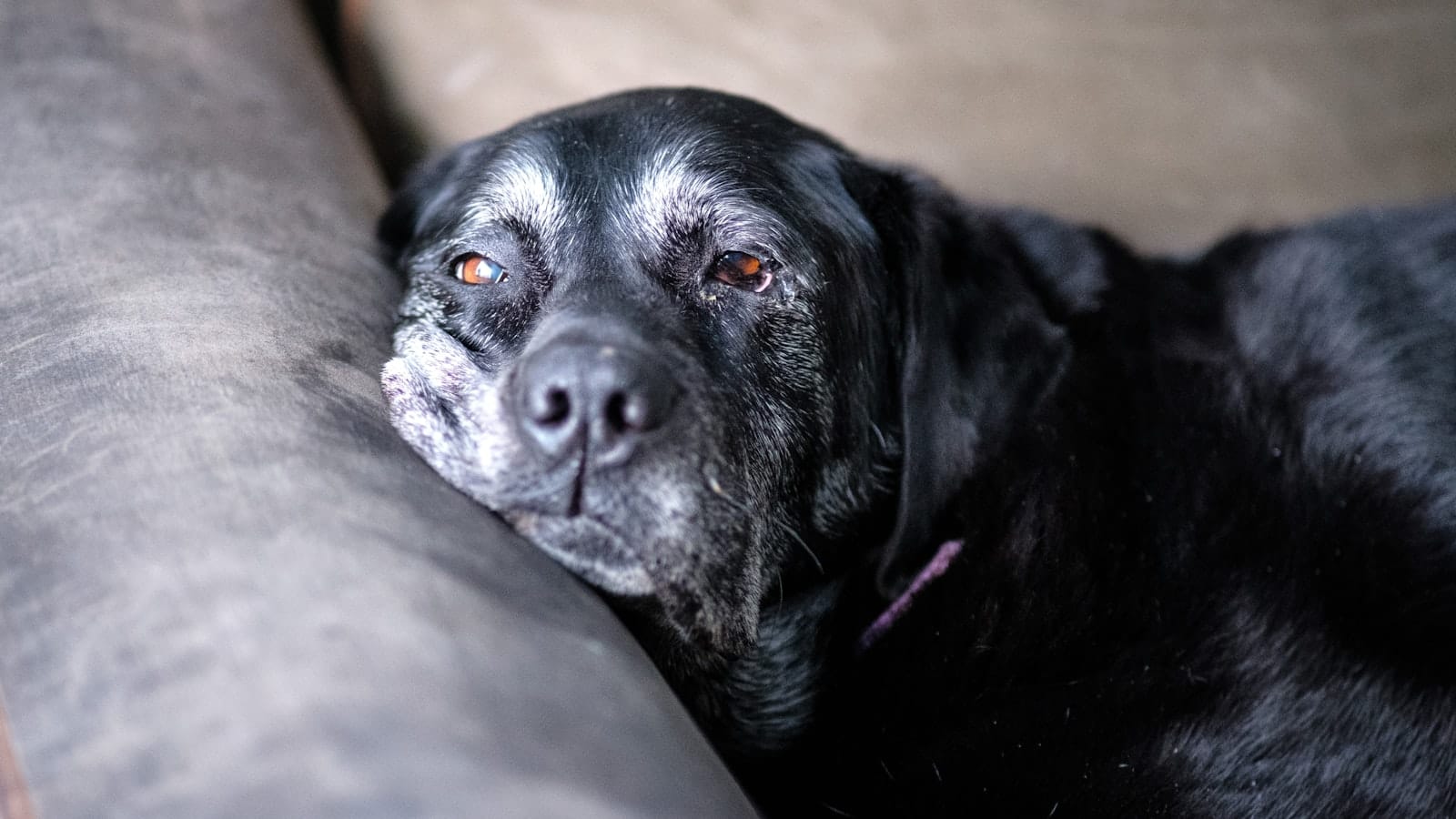
She used to settle the moment you closed the door. Now you can hear her pacing as you reach the car.
Older dogs who have been fine alone for years can develop genuine distress at being left. It is one of the saddest things to come home to, and one of the most quietly fixable, but the older-dog version is not the same as the puppy version. The drivers are different, and the fixes need to be too.
This guide is for owners who have noticed a change. Not a dog who has always struggled, but a dog who has shifted.
The short version
- Sudden separation distress in an older dog warrants a vet check first. Pain, hearing or sight loss, and early cognitive change can all present this way.
- Departures and returns should be calm and predictable, not effusive.
- Build alone-time back up in short, settled chunks. Do not push through long absences.
- Classical music has UK research behind it for kennelled dogs. Television and pop music do not.
- Punishment on return makes everything worse and resolves nothing.
Why separation distress can develop in an older dog
Four things, sometimes more than one at once.
Cognitive change. Canine cognitive dysfunction (sometimes called canine dementia) is more common than most owners realise. UK and international veterinary data put it somewhere between roughly 14 and 35 per cent of dogs over the age of eight, with prevalence climbing sharply in dogs over twelve. Early cognitive change can present as restlessness, sleep-wake cycle disturbance, and new anxiety around being left, all without the dramatic disorientation people associate with full-blown dementia.
Pain. This is the most overlooked driver in older dogs and the one we keep coming back to. A dog who is sore finds being alone harder, because there is no distraction and no comfort. Many dogs labelled "anxious when left" in their senior years are actually uncomfortable and managing it less well alone than they do alongside their humans. The same logic that runs through our guide on the signs of stress in dogs applies here.
Sensory loss. Older dogs with declining hearing or sight find the world more unpredictable. The house creaks differently when you cannot hear the source, and the doorbell becomes a sudden event rather than something with a build-up. This makes being alone feel less safe.
Bereavement and routine change. The loss of another household dog is a common trigger and routinely under-recognised. So is the post-pandemic-era pattern of owners returning to office working after months at home. Older dogs adapt more slowly than younger ones, and what would be a few weeks of grumbling for a five-year-old can be months of genuine distress for a twelve-year-old.
How it actually presents in older dogs
It can look quieter than the classic puppy version. Watch for:
- Pacing or vocalisation at exit points (the door, the window onto the drive), not random barking
- Heavy panting or drooling found on return that was not there when you left
- Indoor accidents in a previously toilet-trained dog
- Destruction specifically near doors, windows, or the route you left by, not random chewing
- A delayed, slightly off settling pattern when you do come home
This is different from canine cognitive dysfunction, which usually shows as disorientation, getting stuck in corners, staring at walls, or the sleep-wake cycle flipping (sleeping all day, restless at night). The two can overlap, which is one of the reasons a vet visit is the first step, not the third.
Rule out pain and medical issues first
In any dog over about seven who has developed a new separation pattern, book a vet visit before changing your routine or starting a behavioural programme. Pain, sensory decline, urinary tract issues, thyroid problems and cognitive change can all sit underneath what looks like anxiety. Our piece on the early signs of arthritis covers the most common offender to rule out.
This is the single highest-value step. Treating a sore or unwell older dog with a behavioural plan alone delays the thing that would actually help.
A gentle settling plan
The principle is steady, low-key, and built up. Older dogs do not respond well to "bootcamp" approaches.
Predictable cues, but calm ones. Use the same simple departure routine each time: a particular phrase, a treat in a specific spot, the same coat. Do not make it dramatic. Effusive goodbyes raise the contrast between you being there and you being gone, which is the opposite of what helps.
Short absences, building up. Start with leaving for two or three minutes and coming back calmly. Build to ten, then twenty. Do not jump from a five-minute test to a four-hour absence. Each successful, calm separation is a deposit; each panicked one is a withdrawal.
A safe spot. A bed she chooses (not one you have decided is the spot), in a room she finds reassuring, with a piece of recently-worn clothing if it helps. Many older dogs prefer a low, easy-access bed to a crate at this stage. Watch your own dog rather than following a rule.
A positive cue tied to being alone. A long-lasting chew or a stuffed Kong given only as you leave creates a small good thing that goes with departure. Frozen Kongs last longer and are kinder on older teeth than hard chews.
Background sound that helps. A 2017 study at the University of Glasgow and earlier work at Queen's University Belfast both found classical music reduced stress signs in kennelled dogs compared with silence, talk radio or pop. Television and rock music did not. If you are leaving sound on, choose accordingly.
What does not help, and often makes it worse
- Punishment on return. A dog who has had an accident, chewed a chair leg, or scratched at the door while you were out is panicking, not protesting. Punishing on return cements the link between you arriving and bad things happening, and the next separation is worse.
- Bark collars and anti-bark devices. They suppress a symptom and increase distress. Avoid.
- Sudden long absences. Coming back from months of home working and going straight to a full day out is the version of "cold turkey" that breaks an older dog's confidence. Build up.
- Constant CCTV checking. Watching the live stream and texting friends about it makes you anxious, which the dog reads on your return. Set a check at the halfway point if you must, then close the app.
Calming support, realistically
In the UK, Adaptil (a synthetic version of the dog-appeasing pheromone, available as plug-in, collar or spray) has reasonable evidence for taking the edge off generalised stress and is widely used by behaviourists alongside training. It is not a cure. It is one tool.
Tailkind takes an evidence-led approach across its range; their Joint Care Mobility Chews are available now, with a calming formulation in development. Either way, calming support is most effective when it sits alongside the work above, not instead of it.
When to involve a behaviourist
For anything entrenched, get qualified help rather than persisting alone. In the UK, look for membership of the Animal Behaviour and Training Council or the Association of Pet Behaviour Counsellors. A clinical animal behaviourist can put a structured desensitisation programme together that suits your specific dog and your specific routine, and your vet can refer if there is a medical layer to address in parallel.
Separation distress that has been building for months rarely fades on its own. It responds well to the right help, and it is worth getting.
Frequently asked questions
Can older dogs develop separation anxiety suddenly?
Yes, and the suddenness is often the point. A genuinely new pattern in an older dog deserves a vet visit before anything else, because pain, cognitive change, sensory loss, urinary issues and thyroid problems can all present as new anxiety around being left. Once medical drivers are ruled out, behavioural work is much more effective.
Will separation anxiety in an older dog get worse over time?
Untreated, usually yes. The dog learns that being alone is unsafe, and the anxiety entrenches. Treated, even modestly, it usually stabilises or improves. The combination of a vet check, calm short absences built up gradually, and a behaviourist for anything stubborn is the standard UK approach and works well in most cases.
Do calming supplements help with separation anxiety in dogs?
For some dogs they reduce the baseline arousal enough to make the behavioural work more achievable. They are a support, not a fix, and they do not replace ruling out pain or building up alone-time gradually. Give any supplement at least four to six weeks at a sensible dose before judging it.
Is it cruel to leave my older dog alone?
No, if you do it well. Most adult dogs cope with being alone for a few hours when they have been built up to it, have a comfortable settling place, and trust that you come back. What is cruel is leaving a distressed dog alone for long stretches without addressing the distress. If your dog cannot yet manage an hour, work on the hour with help before pushing on a longer absence.
Topics