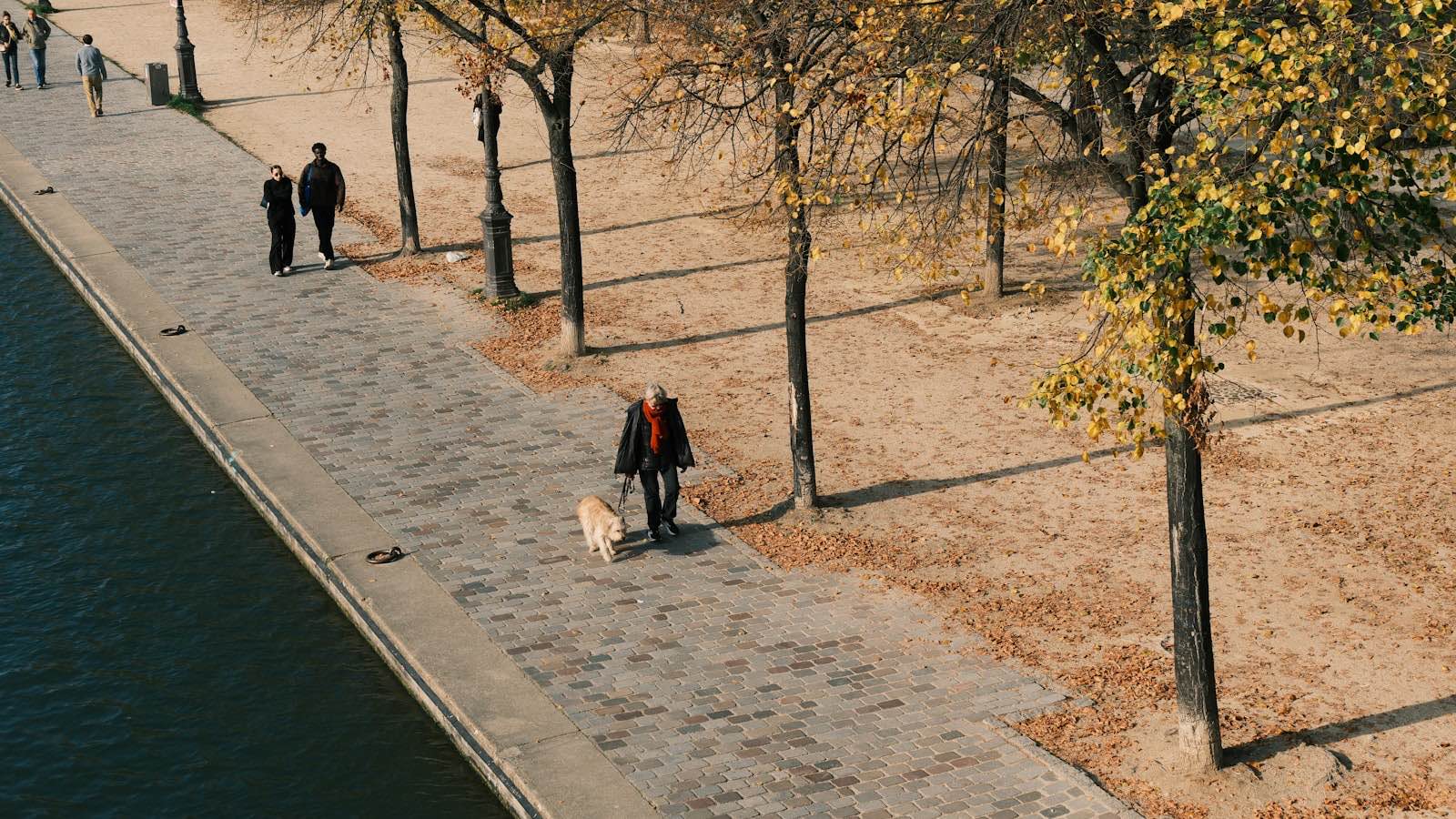
There is a moment many owners of older dogs recognise. The dog who used to drag you out of the door now hesitates at it. The walk that was always a highlight has become something they seem to weigh up. It is easy to read this as a dog who no longer wants to walk, and to quietly let the walks shrink away.
That is almost always the wrong call. Movement is one of the best things for an ageing dog, for the joints, the muscles, the gut and the mind. The trick is not to walk less, but to walk differently. This guide is about how.
The short version
- Older dogs usually need shorter, more frequent walks rather than fewer long ones.
- Let them sniff. Ten minutes of nose-led pottering tires an older dog more pleasantly than a brisk mile.
- Choose soft, even terrain over hard pavement and steep ground.
- Warm up gently and keep them warm afterwards, especially in cold or damp weather.
- A sudden drop in willingness to walk is a vet conversation, not just old age.
Why walks matter more, not less, as a dog ages
It is tempting to think of rest as kindness to an older dog. For the most part it is not. Regular, appropriate movement protects almost everything that ages:
- Joints stay more comfortable with steady use than with rest. Cartilage relies on movement to stay nourished, and the muscle that movement builds is what supports the joint.
- Muscle is lost quickly in older dogs that stop exercising, and once lost it is hard to rebuild. Less muscle means more load through the joints and a faster decline.
- Weight is far easier to manage in an active dog, and excess weight is hard on every ageing system.
- The gut and toilet routine stay more regular with daily movement.
- The mind needs the input. The smells, sights and small decisions of a walk are enrichment that a garden cannot replace.
The goal is to keep your dog moving in a way that gives all of this without overtaxing a body that has changed. That means adapting, not stopping.
Shorter and more often beats long and occasional
The single most useful change for most older dogs is to break the same total time into smaller pieces. Three fifteen-minute walks are kinder than one forty-five-minute march, because they avoid the long stretch where an older dog pushes past comfort to keep up, and they spread the joint load across the day.
Watch your own dog for the turning point. Many older dogs are happy and loose for the first stretch, then noticeably stiffen or slow. That moment is the length their body currently prefers. Aim to turn for home before it, not after, and you will often find their enthusiasm for the next walk holds up far better.
Let them sniff
A walk does not have to cover ground to be a good walk. For an older dog, a slow, sniff-led amble is often more satisfying and more tiring, in the good way, than brisk distance.
Sniffing is genuine mental work. It lowers arousal, occupies the mind, and lets a dog who is physically slowing still feel like they have done something. Some days, the best walk for an older dog is ten unhurried minutes along a hedgerow with their nose down the whole way. Let the dog set the pace and the route more than you used to. The walk is for them.
Terrain and timing
Where and when you walk matters more for an older dog than it did when they were young.
- Surface. Soft, even ground (grass, woodland paths, trails) is gentler on joints than hard pavement, and safer than slippery or uneven surfaces. If pavement is unavoidable, keep those walks shorter.
- Gradient. Steep climbs and descents both load ageing joints heavily. Flatter routes are kinder.
- Warm-up. Let the first few minutes be slow. An older dog taken straight from the sofa into a brisk pace is the equivalent of us sprinting from cold. A gentle start lets stiff joints loosen.
- Weather. Cold and damp stiffen older joints. A coat for a thin or short-haired dog in winter is sensible, and keeping them warm and dry after a wet walk genuinely helps comfort. In summer, the cool of early morning and evening is kinder on joints and far safer in heat. Our guide on when it is too hot to walk covers the warm-weather side.
Support the joints that do the work
Walking well into old age is much easier for a dog whose joints are supported. The foundations are the ones that run through everything we write about senior mobility: keep the dog lean, keep the movement consistent, and consider joint support appropriate to their stage.
Multi-pathway joint supplements, which combine structural, anti-inflammatory and cellular-support ingredients, are well suited to active older dogs. Tailkind's Joint Care Mobility Chews are built around that approach, and our review of UK joint supplements covers how to choose between the options. If you are not sure whether your dog is at the stage to start, our guide on when to begin joint support walks through the timing.
For dogs who are visibly struggling, hydrotherapy and canine physiotherapy can rebuild strength gently, and both are widely available in the UK on veterinary referral.
When a change in walking is a red flag
Most slowing is gradual and normal. Some is not, and it is worth knowing the difference.
See your vet, rather than simply easing off, if your dog:
- Suddenly refuses to walk, or stops partway and will not continue
- Becomes lame, or holds up a leg, during or after walks
- Cries out, or flinches, on movement
- Loses interest in walks over a short period rather than gradually
- Tires dramatically faster than a month ago
These can signal pain, a joint injury, or a medical issue that is treatable, and treating it usually restores far more of the dog's life than managing around it would. Our guides on the early signs of arthritis and the wider senior health check cover what to watch and what to bring to the appointment.
Frequently asked questions
How far should I walk my senior dog?
There is no fixed distance, because it depends on breed, size, fitness and any conditions. The better guide is your own dog: walk to the point just before they stiffen or slow, and turn for home there. For many older dogs, several short walks a day suit them better than one long one. Let comfort, not a step count, set the length.
My older dog seems tired after walks. Should I stop walking them?
Usually no. Some tiredness after a walk is normal and healthy. What you want to avoid is a dog that is exhausted, stiff or sore for hours afterwards, which suggests the walk is too long or too hard for their current state. Shorten and slow the walks rather than stopping them, and see your vet if the tiredness is sudden or severe.
Is it better to walk an older dog or let them rest?
Movement wins, in almost every case. Appropriate, regular walking protects joints, muscle, weight and the mind far better than rest does. The old advice to rest arthritic or ageing dogs has been overturned. The aim is the right kind of activity (gentle, regular, on soft ground), not the absence of it.
Why has my older dog suddenly stopped wanting to walk?
A sudden change deserves a vet visit. Gradual slowing over months is usually normal ageing, but an abrupt refusal to walk, lameness, or rapid loss of interest can signal pain, injury or illness, much of it treatable. Do not write a sudden change off as old age until a vet has had a look.
Topics